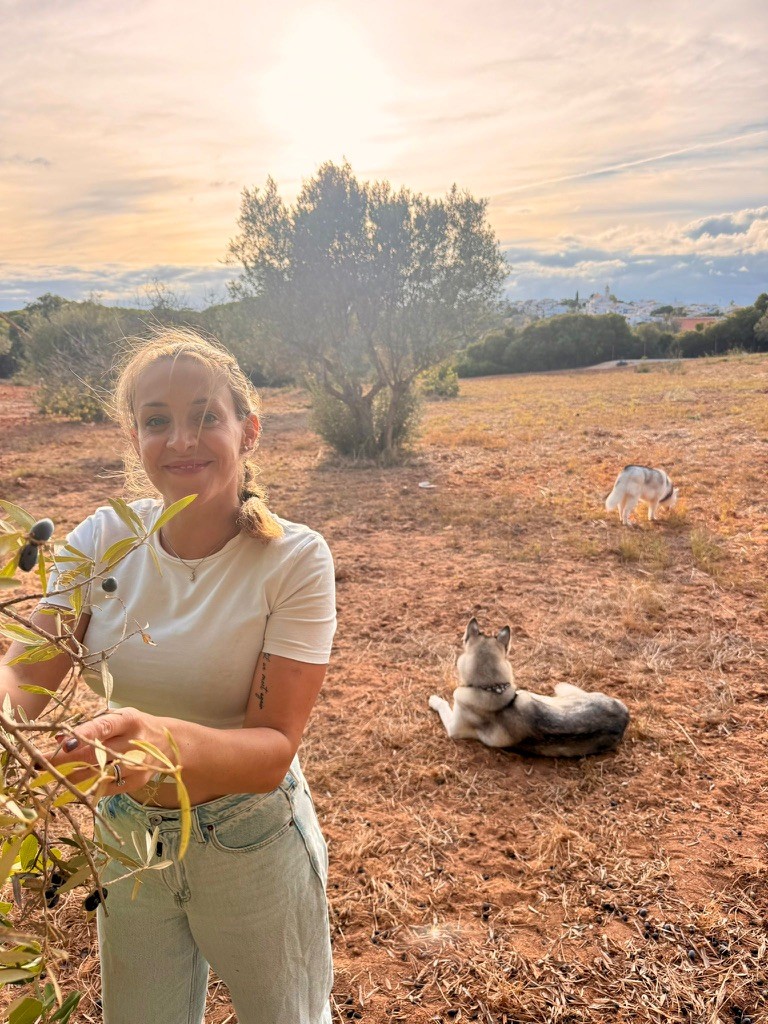
Abbie Shone lives in the Algarve (Portugal) with her husband and their three boys. She runs her own virtual ops business for UK clients. A few weekends ago she ran her first HYROX in Lisbon, on a relay with three other school mums. Before Portugal, she was head of operations at a London company with two hundred people reporting up to her.
None of which sounds like the life of a woman managing a chronic autoimmune disease. That’s sort of the point. Abbie was diagnosed with autoimmune hepatitis six and a half years ago, and has spent the time since making sure it isn’t the headline of her life.
Right after the twins were born, Abbie had an infection she could not shake. Her GYN ran full bloods. Liver count came back high. Three months later her NHS GP said a recheck wasn’t needed. Abbie said please.
“I was really insistent. I don’t normally get such an abnormal blood test.”
The recheck came back high again. That earned her a referral, a biopsy, and a diagnosis: autoimmune hepatitis. No one in her family had it. She had no other symptoms. Without that infection she might never have known.
Her consultant called it the silent killer. The kind of disease where the first sign is being told you need a transplant. Abbie was thirty. Her biopsy showed no cirrhosis. By sheer luck and stubbornness, she had caught it very early.
The disease itself didn’t feel like anything. The medication did.
“The worst feelings I had were on the medications because of the side effects. The actual disease itself, I didn’t know I had.”
Steroids, moon face, the side effects you don’t want at thirty with three small kids and a job. Nearly four months to dial in the right combination.
“Is it possible for me to ever come off these meds?”
The honest answer was no. That’s what she had to sit with.
Abbie, by her own admission, is an overthinker. She Googled. She joined the Facebook groups. She read other people’s stories. And she noticed something.
“I thought, well, you’re letting it defeat you before you’ve even lived with it. Sometimes just to put a label on it can make it worse than it is.”
She isn’t minimising anyone else’s experience. But the future she was constructing in her head was worse than the version she was living. So she stopped constructing it.
Stress was pulling the trigger on her flare-ups, and London life had a lot of it. After COVID, she and her husband were both working remotely. They asked what kind of life they wanted for the boys. Not the one they had.
“Taking the stress away just helped so much with any flare-ups I’d been having.”
They moved to the Algarve. The boys went into Portuguese school speaking none of the language. All three are now fluent, which Abbie suspects they have not yet realised they could weaponise against her.
Asked what she’d say to herself the morning of her biopsy:
“I’d tell myself it wasn’t as big a procedure as I thought it would be. In my head it was going to be way worse than it was.”
Asked what she’d tell someone who just got the same diagnosis:
“Be patient. I expected all of it to be over so quick. With the medications and the appointments, it gets annoying, but eventually some people are lucky enough to get to the remission point. It’s just patience.”
“I just had faith that everything would be fine,” she adds. “They were telling me what I needed to do, and I just did what they told me to do, and stayed on top of it.”
Most days, Abbie doesn’t feel it. School drop-off, gym five times a week, work.
Then there are the other days. Three or four bad ones a year, plus the occasional one bad enough to land her in hospital on a drip. Flare-ups don’t announce themselves the same way twice: joints one time, muscles so tender that touch feels like bruising the next, lately her gums.
“It’s an exhaustion I’ve never felt before. A nap won’t help. It’s just a drain.”
On those days, her husband shows up with smoothies. Ginger, turmeric, anti-inflammatory anything. He also knows how to get her moving, because she’s competitive and he uses that.
Five times a week, after school drop-off, Abbie goes to the gym. The exhaustion doesn’t exempt her. Aching joints don’t exempt her.
“Even if I just sit on a bike and move my legs, I will feel better afterwards. Some of it is mind over matter and not letting it defeat you that day.”
So when her friends from school suggested a HYROX relay, she trained for months. Four mums. Lisbon. A good time on the clock. Her ten-year-old stood at the rail looking like he might be sick on her behalf.
“It’s just not allowing it to be a restriction in your life. It doesn’t have to be.”
She wants the boys to see it. To grow up watching their mum decide an autoimmune disease isn’t what runs her life.
If she could send a message back to the day she was diagnosed, it would be three sentences.
“Stop worrying. Stop over-researching. Stop over-panicking.”
“You still have a life. You’re still here. You have to show up for yourself and fight a little bit for it.”
Today the medication and bloodwork are steady. The boys are loud, the husband makes the smoothies, the gym is five mornings a week. A HYROX medal sits somewhere in the house. Probably another race ahead.
Six and a half years ago she was the woman scrolling Facebook groups at midnight, building a future she didn’t want. She knows what would have helped. She’d like to be that for someone else.
“All this information I wish I had. I would absolutely like to share that.”
Same operator. Different arena. Same answer.