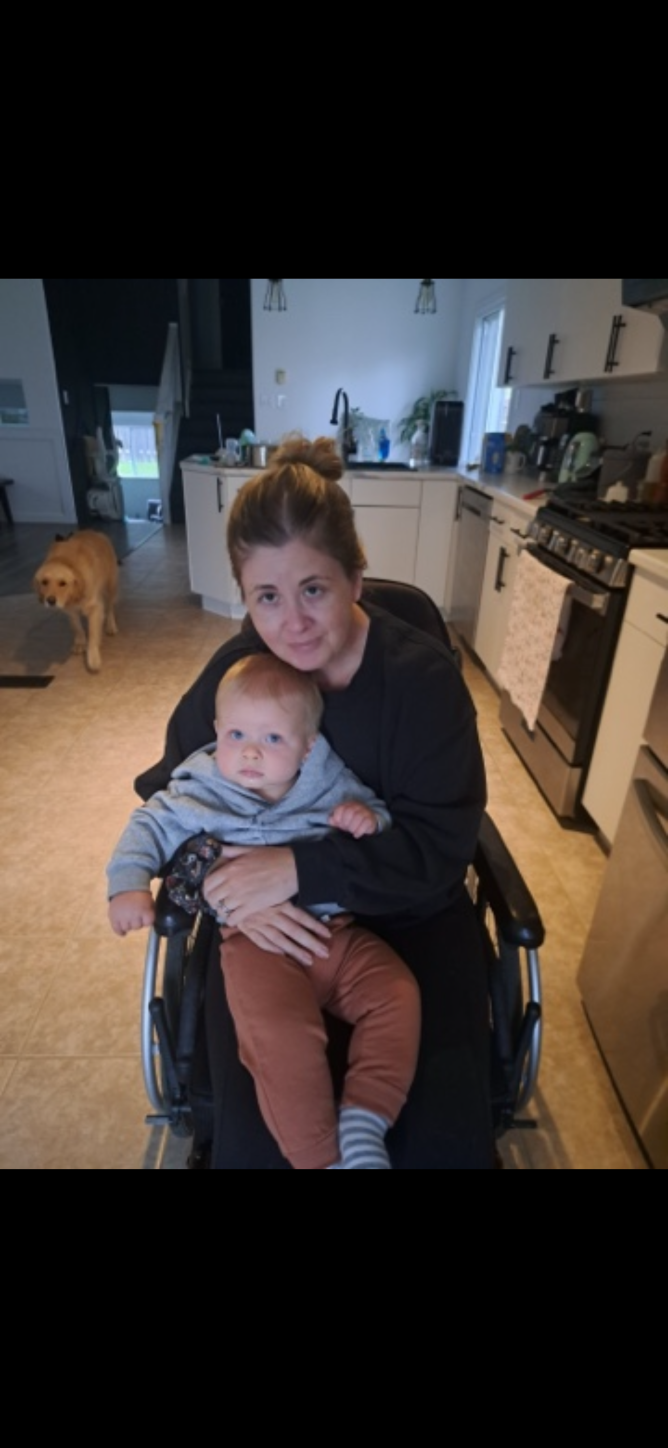
“It almost feels like a dream. I’m telling the story that happened to someone else.”
Britt was thirty-four weeks pregnant when her hands and feet started to tingle. She was busy, active, someone who had played ice hockey in Australia in her twenties, met her husband Gavin at a pub during her first two weeks there, and eventually brought him back to Canada. Before this, she had no medical history to speak of. Gestational diabetes, managed with diet, was the only thing on her radar. So when the tingling came, along with a heavy, worn-out weakness, she reasoned it away. Maybe this was just what being very pregnant felt like.
It was not. Over the next few days the tingling gave way to back pain so severe she says she hopes never to feel anything like it again, pain that traveled into her jaw and kept building. Within about three or four days of her first symptom, she was in the hospital. Her husband, an ER nurse at the time, got her seen quickly. They assessed her, decided it was the flu, gave her an IV, and sent her home. Gavin all but carried her out. She kept telling herself the doctors knew best, that she would feel better in a couple of days, even as she called her OB because she knew, in her body, that something was wrong.
What followed was a fast, frightening slide. She could not get off the couch. Her mother came to stay while Gavin worked. Then she fell backwards down the stairs, her leg simply giving out beneath her, a terrifying thing for anyone and more so for a woman near the end of her pregnancy. When one side of her face began to droop, her mother made the call: this was not the flu, and they were going back.
This time the response was different. A doctor at the local hospital asked whether she had ever heard of Guillain-Barre syndrome, said he needed to make some calls, and moved fast. Within hours she was on her way to a larger center, where a spinal tap confirmed the diagnosis. She was one of the rare acute cases, downhill fast rather than the slower progression she would later learn is more typical. And she was still pregnant.
The doctors had never seen a case like hers, a GBS diagnosis in a pregnant patient, and they were reading medical journals to decide what to do. First they planned to hold off and treat her. Then, with Gavin briefly out of the room sorting out care for their dogs, a doctor returned and said they would induce that day. Pardon? she thought. She had just gotten the diagnosis. She was in unspeakable pain. She had no idea how she was going to do this. But that was where they landed.
Ollie arrived healthy, six pounds thirteen ounces, and spent two weeks in the NICU while Britt was taken to the ICU. She would spend a month there and five months in the hospital overall. For a stretch, Gavin was managing a baby who would not sleep and a wife in intensive care at the same time. The support system around them held: parents, siblings, friends, in-laws, people who drove up and stayed, who found spare rooms, who pieced it together week by week.
She did not get better on the expected timeline. In rehab she was so weak she could not press a standard call bell; they rigged one she only had to touch. One day she could curl a three-pound weight, a real victory, and a week later she was back down to two and stuck there. The team stayed confident she would walk out. She held onto that hope even as her body refused to cooperate, even as CIDP came up once in conversation and then vanished from it. She went home in April still unable to walk, a chairlift installed in the house, someone coming in daily to help with personal care. Those four months at home, she says, were as hard as anything in the hospital.
What she did not know was that CIDP was quietly progressing the whole time, unnamed and untreated.
The family flew to Australia anyway, a trip booked before she got sick, to introduce Ollie to Gavin’s family. Gavin managed her care through the long flight. Her father-in-law connected her with a physiotherapist there, and that work, she believes, is a big part of why she began standing a month after coming home.
Back in Canada, her rehab doctor, the one she calls her quarterback for coordinating everything, admitted he did not know what was going on and sent her for more testing. An MRI ruled out a brain tumor. Another spinal tap, another round of IVIG. Then a neurologist who specialized in this area looked at her results and said she thought it might be CIDP. The test confirmed it in August 2023, roughly eight months after her first symptom. Prednisone helped enormously, and she was miserable about being on steroids but open to trying. Combined with regular IVIG, the treatment she had needed all along, it worked. That was when she started walking, cooking, moving through her days with energy again.
When she first heard the word CIDP, she felt grief. GBS was something you might get through and set down. Chronic was different. The first thing she Googled was whether people die from it. She learned, in time, that they generally do not, and that almost everyone’s version of the disease looks a little different from everyone else’s.
Today Britt is back at work as a senior account executive, on camera and customer-facing most days. She does Pilates three times a week. She still has facial paralysis, which she was deeply self-conscious about returning to a high-pressure, visible role, and lingering neuropathy in her feet, balance she is still slowly rebuilding. She insists she has not plateaued, just that the improvements come in small increments now.
The hardest part is often the part no one sees. There is a lot of determination happening behind the scenes that people without an illness like this would never have to think about. Her message, if she has one, is simple: be mindful, because you truly do not know what someone is carrying.
She has built a small online community, mostly women, many of them mothers diagnosed during pregnancy or postpartum, the people whose stories echo her own. Hearing that someone else has been through something like it is, she says, its own quiet comfort. CIDP can make you feel like you are on an island. Finding a common thread in someone else’s story is how you learn you are not.
There is a parallel she keeps coming back to. Three years ago she was learning to stand, learning to walk, learning to eat again, in the very same season Ollie was doing all of it for the first time. The son she was terrified she would never get to hold turned out to be the thing that refused to let go. He is her constant, her go-to, bonded to her in a way that still stops her in her tracks. The bond she grieved in the ICU is the one thing the disease never got to take.
One day she will tell him. She will tell him about the year his mother learned to walk while he learned to walk, and by then it will land on him the way it now lands on her: like something that happened to someone else, someone braver, in a story she is astonished to have lived all the way through.
Until then she keeps telling it to the people who need it now. The women who message her page newly diagnosed, scared, pregnant or just postpartum, googling the same terrifying questions she once typed at 2 a.m. She cannot give them their old bodies back any more than she got hers. What she can give them is the one thing she went looking for and could not find: proof that someone else made it to the other side, and is standing on it, waiting.