Welcome to the Family:
Victoria’s Journey with gMG
Victoria spent seven years being told her bloodwork was normal. She has generalized myasthenia gravis. Her antibody tests never proved it, and almost nobody believed her.
Welcome to the Family
For seven years Victoria's tests kept coming back normal. She has generalized myasthenia gravis. She's just one of the patients whose bloodwork never proves it.
Victoria has about two hundred houseplants. She's a chemist in a lab in South Georgia.
"I love plants," she says, a little defensively. She's taken up ceramics too, mostly so she can make her own pots. She's going in tomorrow to start a new one.
These days she also posts videos about myasthenia gravis on TikTok, for people who are roughly where she was a few years ago. Getting there took seven years, two stays in intensive care, and one doctor willing to look something up.
"Maybe nothing's wrong with me"
It started in her face, about seven years ago. Her right eyelid drooped and her smile froze on one side. She had double vision, weakness through both legs, and trouble getting words out.
"The biggest one was the drooping eyelid."
Her doctor didn't know what it was and sent her to a neurologist. The neurologist didn't know either. He ran bloodwork, didn't find what he was looking for, and closed the file.
Victoria is seronegative, which means her antibody tests come back negative even though she has myasthenia gravis. It's the same disease everyone else has. She just can't produce the paperwork for it.
"Seronegative patients really struggle with being listened to and taken seriously," she says. "Because my blood work came back negative, he just wrote it off."
So she went home and stopped asking.
"After that, I just gave up. Honestly, I was like, maybe nothing's wrong with me." She stops for a second. "But something clearly was wrong with me."
She lived like that for years, quietly certain of something she couldn't demonstrate. "I just don't think science has caught up yet."
"Don't look it up"
Then she got COVID for the third time, and everything came back at once. The ptosis, the double vision, the weakness, and this time something new. She couldn't breathe properly.
By then she had a different primary care doctor. He didn't know what was wrong either. What he did differently was start Googling.
"He was like, something's not right. Have you ever heard of myasthenia gravis?" She hadn't. "And he was like, okay, well, don't look it up. You probably don't have it."
She had it.
He pushed to get her in front of the one neuromuscular specialist in town, whose specialty happened to be myasthenia gravis. It still took months. "As soon as he steps into the office, he was like: you have myasthenia gravis."
"That day I got diagnosed, it was so much relief. I knew this wasn't in my head. But it was so much validation. Like, yeah, this is really happening to you. And now we have a pathway forward."
There was a camera crew in the office that day, filming something unrelated. Months later Victoria ran into the videographer around town and told him he had filmed the worst day of her life. He was confused. He thought he'd been shooting a routine appointment.
Both are true of the same afternoon, and she says them a minute apart without noticing.
After the camera crew left
Insurance denied the IVIG.
A few weeks after her diagnosis she was in intensive care. It was her birthday. They gave her IVIG there and she got better, and the approval still didn't come. In April she was back in the ICU for another week.
"These hospital bills are going to be more expensive probably than a whole year of IVIG."
She took three months of leave, afraid she'd never work again. "I can't live off of disability, and most people can't."
She cried every day for about three months. She cried after her infusion nurse packed up and left, every single time, because "this is my life now." From an ICU bed she texted her bowling team to say she had to quit. She grew up bowling. She isn't up for it quite yet, but she's thinking about it again.
She is blunt about what she thought of encouragement during that stretch. "I hated, hated, hated it when everyone's like, stay positive."
Brushing her teeth like a normal human
The IVIG came through eventually, and then her dose went up, and things started moving the other way.
"I'm not having to take breaks when I brush my hair or shower. I can brush my teeth like a normal human."
On bad days her legs feel "like concrete and Jello at the same time." None of it shows. "On the outside, I look okay. They don't understand I can't walk fifty feet."
Welcome to the family
She started talking about all this in public before she even had a diagnosis.
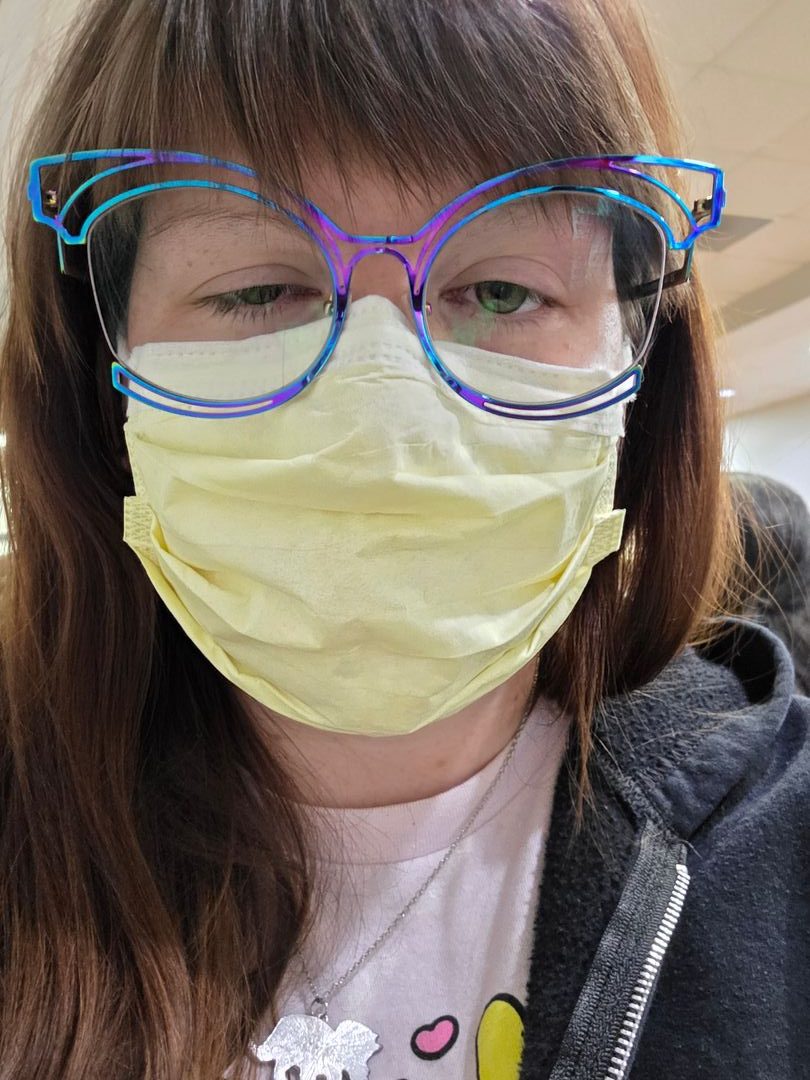
Back when nobody could tell her what was wrong, Victoria found myasthenia gravis groups on Facebook, joined all of them, and posted a photo of her own face along with her story.
The first comment somebody left said, "Welcome to the family."
The community recognized what was happening to her face before the medical system managed to name it.
That's why she's on TikTok now. "I'm very awkward and anxious," she says, and does it anyway. "But if one of my videos can help one person, then it's worth it. I don't want people to walk this road alone."
Then, more quietly: "I wish I had someone like me."
She'd like the education to reach further than that. Nurses keep telling her they covered myasthenia gravis in five minutes of training, one slide in a PowerPoint, because rare disease gets taught as the thing that never comes through your door.
"But here I am."
She has an idea about fixing that, and she's the first to say she doesn't know how you'd pull it off. "I think it would be really cool to travel to hospitals and have a patient just educate everyone on the disease."
Destin
Next week she's going to the beach at Destin, where she and her husband got married. She's been working out what she might be able to do there now.
"I'm so excited to go. Maybe I can be in the sun most of the day, and be able to walk back to the condo."
She still won't tell a newly diagnosed person to stay positive. She remembers too clearly what that sounded like from the other side. What she says instead is learn everything you can, and never stop advocating for yourself. Then, having spent a year getting there herself, she'll add the rest of it.
"Even though it sucks right now, there is light at the end of the tunnel."
About Victoria MaskuleVictoria Maskule is 34 and works as a chemist in a lab in South Georgia. She was diagnosed with seronegative generalized myasthenia gravis in March 2025, seven years after her first symptoms appeared. She keeps about two hundred houseplants, makes her own ceramic pots, and posts about life with myasthenia gravis on TikTok, where she talks to people who are newly diagnosed or still waiting for answers. She advocates for seronegative patients and for better clinician education on rare disease.View TikTok ProfileRelated Resources
Curated stories, expert voices, and research all connected to this condition.


